Global Crypto Regulation in 2026: Brazil's Transfer Delays and the Mining Divide
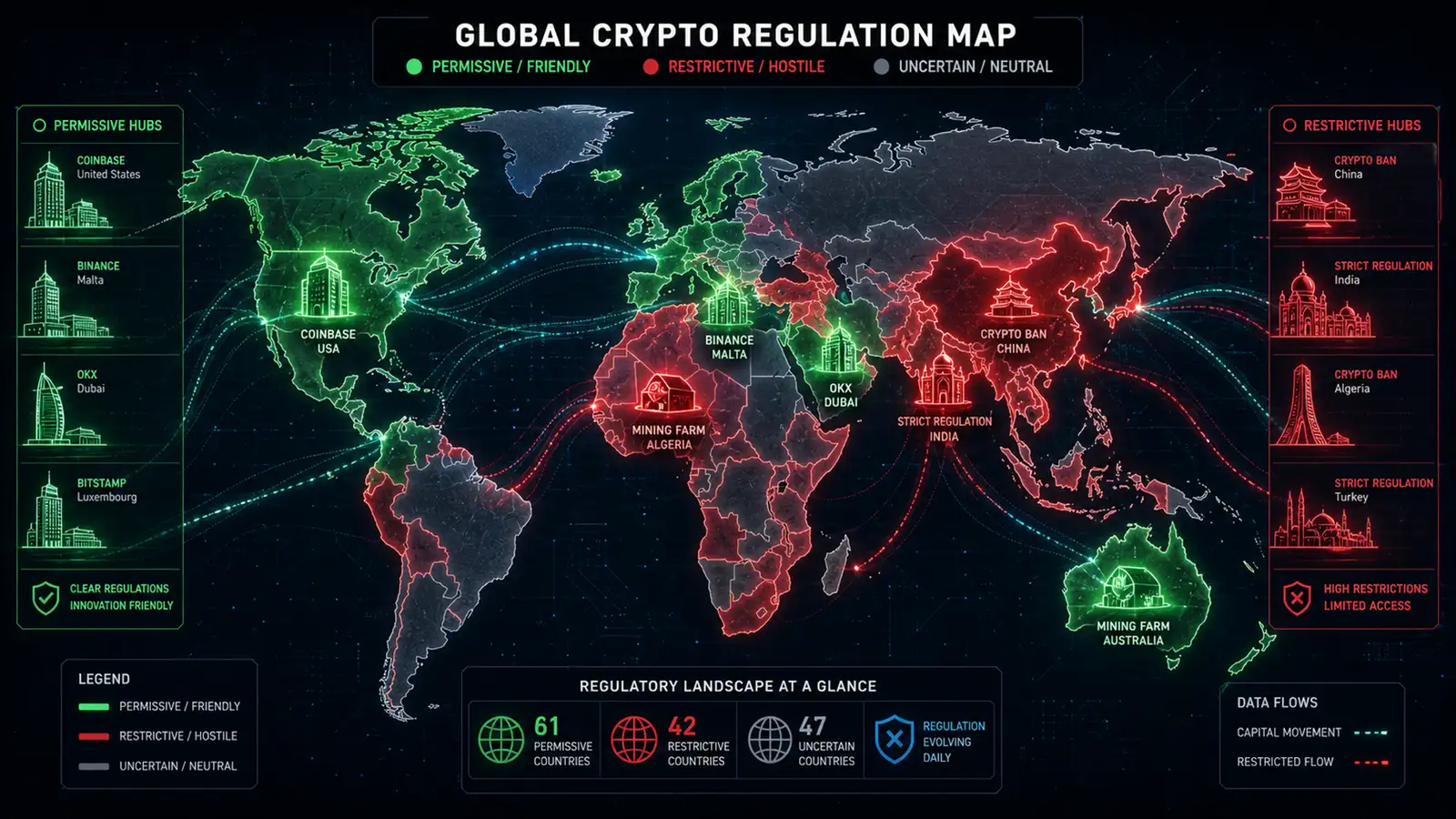
Crypto regulation in 2026 is no longer a theoretical debate. Governments are making concrete decisions that affect how exchanges operate, how miners run their businesses, and how users move their money. Two stories from this week illustrate the breadth of these changes: Brazil’s central bank imposing transfer delays on crypto exchanges, and a growing global divide over how to regulate mining.
These are not isolated events. They are part of a pattern that is reshaping the crypto industry from the outside in.
Brazil’s 24-hour hold
On August 7, Brazil’s central bank published Resolution BCB No. 584/2026, a new anti-fraud rule that takes effect January 1, 2027. The regulation requires crypto exchanges to delay customer transfers to foreign platforms and self-custody wallets for up to 24 hours when the transfer exceeds $10,000 equivalent, whether through a single transaction or multiple transactions on the same day.
Smaller transfers may also face delays if an exchange flags them as risky based on its own internal risk assessment. The central bank said the measure is necessary because cryptocurrencies, including stablecoins, are being used to move funds obtained through financial fraud before victims or institutions can recover them.
The rule is not a permanent freeze. Exchanges can release a transfer before the 24-hour window expires if their risk review finds no signs of wrongdoing. They must document the decision and notify the customer when a transaction has been placed on hold.
This is a significant shift for Brazil’s crypto market. The country has one of the largest crypto adoption rates in Latin America, with Chainalysis data suggesting that Brazilian users received over $90 billion in cryptocurrency between mid-2024 and mid-2025. Exchanges have operated with relatively light regulatory touch until now, and the market has grown rapidly as a result.
The new rule introduces friction into every large transfer, which will affect everything from individual investors moving assets to cold storage to businesses using crypto for cross-border payments. For a market that has prided itself on speed and low barriers to entry, the 24-hour hold represents a fundamental change in how crypto is used in the country.
Regina Pedroso, president of Brazilian tokenization group Abtoken, warned that the policy could impose costs on legitimate users and weaken the competitiveness of domestic exchanges. Her concern is practical: if Brazilian exchanges impose holds that foreign exchanges do not, users will simply move to platforms outside Brazil’s jurisdiction. The regulation may push activity offshore rather than making it safer, which would be the opposite of its intended effect.
The central bank appears aware of this risk, which is why the rule includes the early-release option. An exchange that can demonstrate through its risk assessment that a transfer is legitimate can release it before the 24 hours expire. This puts the burden on exchanges to build sophisticated compliance systems, which will favor larger, well-funded platforms over smaller competitors. The practical result is likely to be market consolidation. Smaller exchanges that cannot afford to build the required risk assessment infrastructure will either merge with larger players or exit the market entirely.
The timing is notable. Brazil’s regulation takes effect January 1, 2027, giving exchanges roughly four months to build the necessary systems. For an industry that has historically moved slowly on compliance, this is an aggressive timeline. Exchanges that fail to meet the deadline face penalties under Brazil’s existing financial regulations, which can include fines and operational restrictions.
The mining regulation patchwork
While Brazil focuses on transfer controls, the global picture for crypto mining is fragmenting in a different direction. According to analysis from the Bitcoin Foundation, crypto mining in 2026 faces a patchwork of energy, taxation, industrialization, and financial regulations that vary dramatically by jurisdiction.
Some countries are embracing mining as an economic opportunity. Others are imposing regional restrictions, special tariffs, and environmental accountability requirements that make large-scale operations increasingly difficult.
Texas offers a case study in the tension. The state has attracted significant mining operations with cheap electricity and a business-friendly regulatory environment. But it now requires qualified Bitcoin miners to register with the state’s energy regulator, a recognition that mining operations can strain local power grids during peak demand periods. The registration requirement is not hostile to mining, but it signals that the era of operating without oversight is ending.
Globally, the trend is toward more registration and reporting requirements. Large-scale mining operations may face company licensing, land use permits, electricity agreements, environmental impact assessments, customs obligations, and Bitcoin mining-specific compliance requirements. The exact combination depends on the country, but the direction is consistent: more rules, more paperwork, more accountability.
Why uniform global regulation is unlikely
The Bitcoin Foundation analysis makes an important point: a uniform global regulation of crypto mining is unlikely. Countries differ too fundamentally in their electricity policies, taxation approaches, and environmental priorities to agree on a single framework.
What is happening instead is convergence on specific standards. Anti-money laundering rules, beneficial ownership laws, sanctions compliance, crypto taxation, and sustainability disclosure are becoming standardized across jurisdictions. This does not create a single global rulebook, but it creates a set of common requirements that miners and exchanges must meet regardless of where they operate.
For miners, this means compliance costs are rising everywhere, even in friendly jurisdictions. A mining operation in Texas must now register with the state energy regulator, comply with federal tax reporting requirements, and potentially meet environmental disclosure standards. The same operation in Kazakhstan faces a different set of rules focused on energy pricing and licensing. And in Norway, it must navigate carbon emission reporting and noise regulation.
The practical effect is that mining operations must maintain compliance teams familiar with multiple jurisdictions. This is a significant overhead cost that did not exist five years ago, and it disproportionately affects smaller miners who cannot spread those costs across large-scale operations. The question is no longer whether you need to comply with regulations, but how many different regulatory frameworks you need to navigate simultaneously.
The stablecoin problem
Brazil’s regulation specifically mentions stablecoins as a tool for moving fraud proceeds. This is not unique to Brazil. Regulators worldwide are increasingly focused on stablecoins because they combine the speed of crypto with the stability of fiat currency, making them ideal for both legitimate payments and illicit transfers.
The challenge for regulators is that stablecoins serve both purposes simultaneously. A transfer that looks like fraud to a central bank might be a legitimate remittance from a Brazilian worker to their family abroad. A transfer that looks like a routine payment might be the final step in a phishing scam. The volume of stablecoin transactions has grown exponentially, with Tether’s USDC and Circle’s USDC processing billions of dollars daily, and regulators are struggling to distinguish between legitimate and illicit flows.
Brazil’s approach, a mandatory hold with the option for early release based on risk assessment, is a middle path. It does not ban stablecoin transfers or impose blanket restrictions. It creates a cooling-off period that gives exchanges time to verify that a transaction is legitimate. Whether this approach will be effective depends entirely on how well exchanges implement their risk assessment systems.
Other countries are watching Brazil’s experiment closely. If the 24-hour hold proves effective at reducing fraud without destroying legitimate crypto activity, similar rules may appear in other Latin American countries and beyond. If it drives activity offshore and fails to reduce fraud, it will serve as a cautionary tale about overregulation.
The broader trend is clear. Stablecoin regulation is tightening globally. The EU’s MiCA framework, which took full effect earlier this year, includes specific provisions for stablecoin issuers. The United States is still debating federal stablecoin legislation, but several states have already implemented their own requirements. Japan, Singapore, and Hong Kong have all introduced or tightened stablecoin rules in the past year.
For the crypto industry, the message from regulators is consistent: stablecoins are too important to leave unregulated. The question is not whether stablecoins will be regulated, but how tightly, and whether the regulations will be practical enough to allow legitimate use while catching illicit flows.
What this means for the industry
The crypto industry in 2026 is being shaped by regulatory decisions made in capital cities around the world. Brazil’s transfer delays and the global mining regulation patchwork are two manifestations of the same underlying trend: governments are no longer asking whether crypto needs regulation, but how to regulate it effectively.
For exchanges, the implication is clear. Compliance infrastructure is no longer optional. Brazil’s 24-hour hold rule requires exchanges to build real-time risk assessment systems, customer notification processes, and documentation protocols. These are not cheap to implement, and they will favor larger exchanges with the resources to build sophisticated compliance operations.
The geographic distribution of these regulatory changes is creating a new map of crypto activity. Countries with clear, predictable regulation, even if strict, are attracting more activity than countries with ambiguous or hostile approaches. Predictability allows businesses to plan and invest. Ambiguity forces them to either take risks or leave.
For miners, the implication is equally clear. Operating in a regulatory gray zone is no longer viable. The registration requirements in Texas, the environmental rules in various European countries, and the taxation frameworks being implemented globally all point to a future where mining is a regulated industrial activity, not a free-for-all.
For users, the immediate impact is friction. Transfers take longer. Documentation requirements increase. The crypto experience becomes more like traditional banking, which is either a step forward or a step backward depending on your perspective. For those who adopted crypto specifically to avoid the delays and paperwork of traditional finance, the convergence is unwelcome. For those who want crypto to become a mainstream financial tool, the regulation is a necessary step toward that goal.
The crypto industry wanted legitimacy. In 2026, it is getting it, complete with all the bureaucratic weight that legitimacy carries. The path forward is not regulation or deregulation, but smarter regulation that adapts to the speed of the technology it oversees. The question for the next year is whether regulators can strike the right balance between preventing harm and allowing innovation. Brazil’s experiment with transfer delays will be one of the first major tests of that balance, and the results will influence regulatory decisions far beyond Latin America.