Kraken Is Rebuilding Around AI Agents and Chasing a Banking License. The Exchange Era Is Ending.
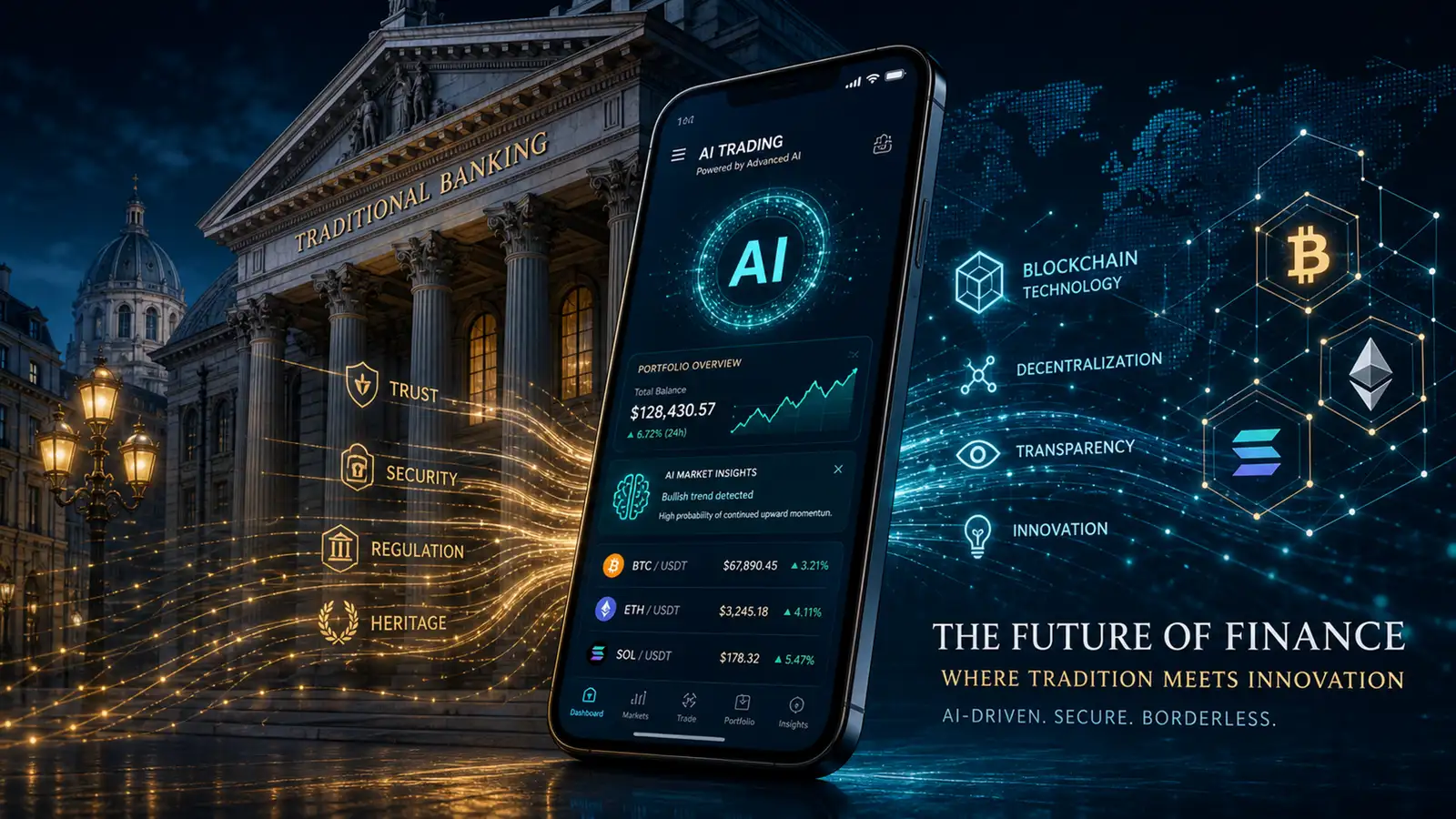
Kraken is doing two things this month that, taken together, tell you exactly where the crypto industry is heading. It is rebuilding its entire app around AI agents that trade on your behalf. And it is pursuing a full European banking license.
Neither move is a gimmick. The first one changes how retail investors interact with markets. The second one changes what kind of company Kraken — and by extension, every major crypto exchange — is trying to become. Together, they represent the most coherent attempt yet by a crypto-native company to become something that looks less like Binance circa 2021 and more like a next-generation financial institution that happens to have started in crypto.
The exchange era, where crypto platforms were just places to swap tokens, is winding down. What comes next looks more like a bank with an AI co-pilot.
Agentic trading, explained
Kraken told CNBC exclusively on July 10 that its rebuilt app will put agentic trading at the center of the user experience. If you have not heard the term before: agentic trading is when AI agents autonomously make trading decisions, execute transactions, and manage portfolios based on goals you set in plain English.
This is not the same as the automated trading bots crypto traders have used for years. Those bots follow fixed rules — buy when RSI drops below 30, sell when it hits 70, repeat. They work until market conditions change, then they break. Agentic systems are different. They evaluate multiple variables at once, learn from new information as it arrives, and adjust strategy within the boundaries you define. You tell the agent “I want to accumulate Bitcoin on dips but never exceed 20% of my portfolio,” and it figures out the rest — which exchanges to route through, how to split orders to minimize slippage, when to wait and when to act.
The technical architecture underneath this is the interesting part. Kraken has not disclosed the specific models powering its agentic layer, but the general approach in the industry involves large language models that interpret natural-language instructions, combined with specialized execution engines that handle order routing, risk checks, and compliance. The LLM decides what to do; the execution layer makes sure it happens within the guardrails. This separation matters because it means the AI is not directly connected to the order book — there is always a rule-based safety layer between intent and execution.
Kamo Asatryan, Kraken’s chief data officer, framed it in terms that sound almost utopian: “AI is going to help everyday people respond to market conditions the way our most active traders respond.” He pointed out that professional traders stay active even during downturns — they find opportunities in volatility that retail investors typically miss because they are asleep, at work, or just not monitoring 47 charts at once.
“In this new world, there’s an opportunity for everyday people to become high-frequency traders and do so using plain English by just talking to their well-informed best friend,” Asatryan said.
Strip away the marketing language and the proposition is this: Kraken wants to close the information and execution gap between institutional traders and the person checking CoinGecko on their lunch break. Whether that gap should be closed — whether giving retail investors AI-powered trading agents is a good idea — is a separate question that Kraken’s announcement does not spend much time on. But someone will ask it, and the answer will shape whether agentic trading becomes a standard feature or a regulatory casualty.
The banking license: why it matters more
Three days after the CNBC exclusive, KITCO reported that Kraken is pursuing a full European banking license. This is the bigger story, even if it generated fewer headlines.
A banking license lets Kraken do things a crypto exchange cannot: hold customer deposits that are insured, offer lending products, issue debit cards that connect directly to bank rails, and operate across the EU under a single regulatory framework rather than piecemeal national registrations.
Kraken is not alone in this race. Ripple secured its full EU MiCA (Markets in Crypto-Assets) license on July 6. Binance has been working toward its own EU license. Italian fintech Conio got its EU crypto services license in mid-June. The pattern is unmistakable: everyone who matters in crypto is trying to become a regulated financial institution before the window closes.
The strategic logic is straightforward. Crypto-native revenue — trading fees, primarily — is cyclical, competitive, and under constant pressure from decentralized exchanges that charge nothing. Banking revenue — interest on loans, interchange fees on card transactions, deposit-based funding — is steadier and generates higher margins. A company that can do both has a business model that survives bear markets instead of scrambling through them.
Europe is the logical starting point because MiCA provides something the US still lacks: a clear, unified regulatory framework for digital assets. Under MiCA, a company licensed in one EU member state can operate across all 27. The framework covers stablecoin issuance, consumer protection standards, capital requirements, and custody rules — everything a company needs to build a banking-like operation on top of a crypto foundation.
The US approach, by contrast, remains a patchwork of SEC enforcement actions, CFTC jurisdiction disputes, and state-level money transmitter licenses that do not talk to each other. A crypto company operating in all 50 states needs 50 separate licenses, each with its own compliance regime. The cost and complexity of that setup makes the EU’s passport system look like an obvious competitive advantage. If you are a crypto company deciding where to plant your regulatory flag, Europe looks like the adult in the room.
This regulatory divergence is starting to produce real consequences. Companies are incorporating in Dublin, Luxembourg, and Frankfurt rather than Delaware. Talent is following the legal certainty. And the products that get built for European customers — insured deposits, regulated lending, debit cards that work everywhere — are increasingly different from what US customers can access.
What the combined strategy says
Agentic trading and a banking license look like separate moves, but they are aimed at the same target. Kraken is betting that the future customer does not want a crypto exchange — they want a financial platform that handles everything from savings to trading to payments, with AI doing the heavy lifting.
That customer probably does not care whether their returns come from Bitcoin, an S&P 500 ETF, or a high-yield savings account. They care about the outcome, not the asset class. Kraken’s strategy is to own the relationship with that customer before traditional banks figure out how to offer the same thing.
The banks are not sitting still. JPMorgan’s Onyx platform has been processing blockchain-based transactions for years and recently expanded into tokenized Treasury funds. BlackRock’s Bitcoin ETF has brought crypto exposure to millions of brokerage accounts that never touched a self-custody wallet. Goldman Sachs is building its own digital assets platform. The window for crypto-native companies to become banks is open, but it will not stay open forever — and the incumbents have balance sheets and regulatory relationships that no crypto company can match.
The other risk is the agentic trading piece itself. Giving retail investors access to autonomous AI trading agents raises genuine questions about consumer protection. What happens when an agent makes a bad trade? Who is liable? Does the average user understand the parameters they are setting, or are they essentially handing the keys to a black box that can lose money faster than they ever could on their own?
Kraken has not addressed these questions publicly yet, and regulators in both the US and Europe will almost certainly demand answers before agentic trading goes mainstream.
The end of the exchange era
For the past decade, the crypto industry has organized itself around exchanges. They were the on-ramps, the liquidity hubs, the brands that defined the space. Coinbase went public. Binance became the largest exchange in the world by volume. FTX collapsed and took a chunk of the industry’s credibility with it. Through all of it, the exchange was the center of gravity.
But that model is running out of road. Trading fees are compressing toward zero — Coinbase reported that its average retail trading fee has dropped from roughly 1.5% in 2021 to well under 1% today, and decentralized exchanges on Solana and Base routinely undercut even that. DeFi protocols offer lending, borrowing, and yield without any intermediary taking a cut. And the customers who remain want services — earning interest on idle balances, paying rent with a crypto debit card, borrowing against their holdings instead of selling them — that exchanges were never architected to provide.
Kraken’s pivot is the clearest signal yet that the industry’s largest players understand this. They are not trying to build better exchanges. They are trying to stop being exchanges altogether and become something closer to what Charles Schwab looks like in 2026: a platform where stocks, crypto, banking, and AI-powered tools coexist in one app.
Coinbase is on a parallel track with its Base L2 network and its “super app” ambitions. Binance, despite its regulatory troubles, keeps adding traditional financial products. Revolut, which started as a banking app, now offers crypto trading to 45 million users and is blurring the line from the other direction. The convergence is happening from both sides, and Kraken’s agentic trading + banking license combo is the most explicit version of the thesis yet.
Whether they succeed depends on regulators in Brussels and Frankfurt more than on anything happening in Silicon Valley. But the direction is set. The company that shows up in your financial app five years from now might still be called Kraken, or Coinbase, or Binance. It just will not look much like the place where you once bought your first Bitcoin. It will take your paycheck, pay your bills, manage your investments with AI, and not particularly care whether the underlying asset is a token or a Treasury bond.
Sources: CNBC exclusive (July 10, 2026); KITCO Crypto SWOT (July 13, 2026).