Quantum Error Correction Hits a New Milestone — but the Finish Line Is Still Far Away
Quantum Error Correction Hits a New Milestone — but the Finish Line Is Still Far Away
Quantum computing just cleared one of its hardest technical hurdles, and the reaction from the research community is cautiously optimistic rather than triumphant. Google DeepMind and IBM both released data in the past month showing logical qubits operating below the error correction threshold — a benchmark that means quantum error correction is theoretically possible at scale. The achievement is real. The gap between “theoretically possible” and “practically useful” remains vast.
What “below threshold” actually means
Quantum computers are inherently noisy. Physical qubits — the actual quantum hardware — lose their quantum state (decohere) in microseconds to milliseconds, and every gate operation introduces errors. For a quantum computer to do useful work, you need error correction: encoding a single “logical” qubit across many physical qubits so that errors can be detected and corrected without destroying the quantum information.
The critical benchmark is the error correction threshold. If the physical error rate of individual qubits and gates falls below a certain level — roughly 1% for the most common surface code approach — then adding more physical qubits to a logical qubit actually improves its reliability rather than making it worse. Above the threshold, more qubits means more noise, and error correction makes things worse.
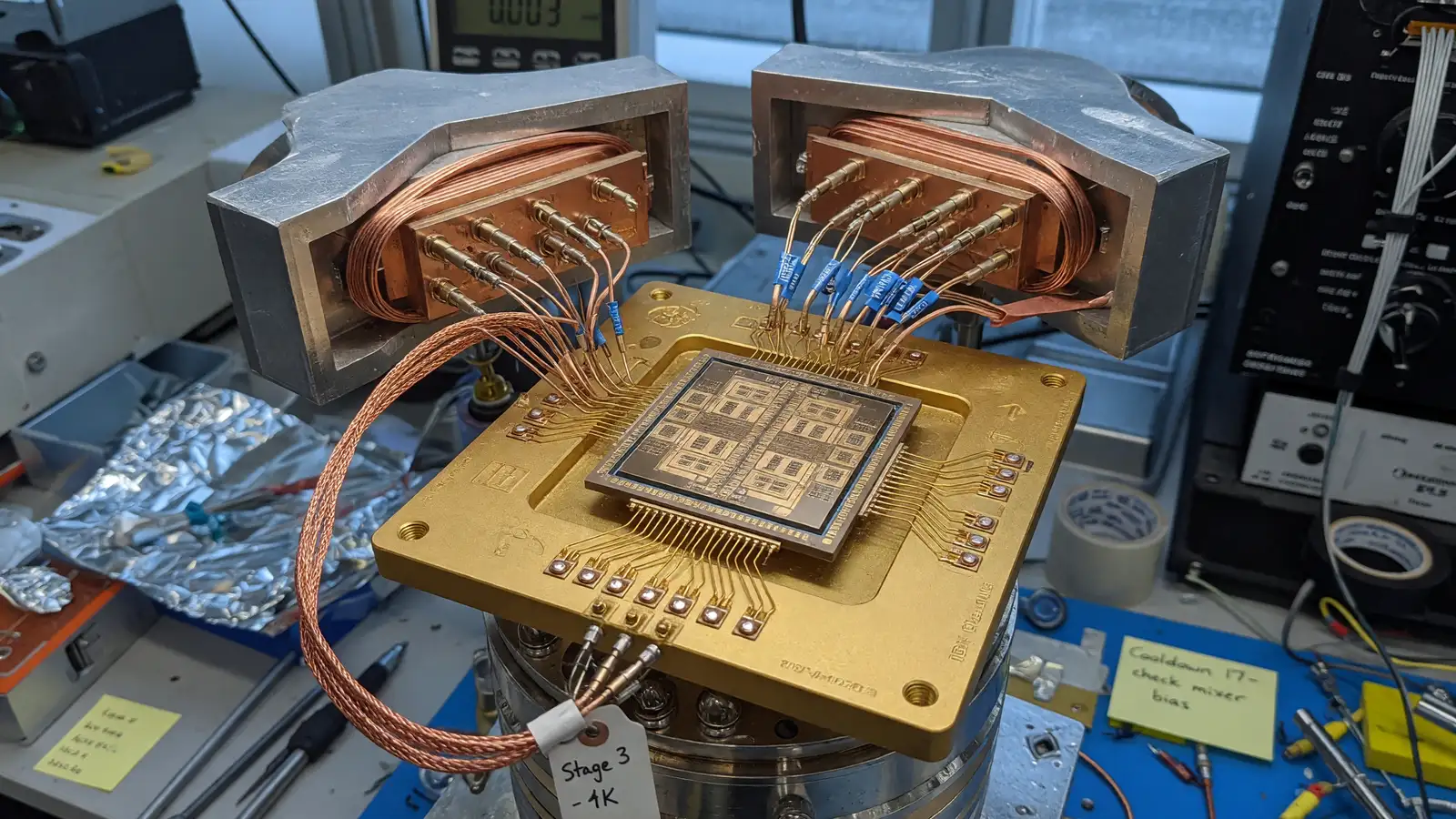
Google’s Willow chip, which operates at 105 physical qubits, demonstrated this below-threshold behavior in late 2024 and has continued refining the results through 2025-2026. IBM’s Heron processor, with its modular architecture, achieved 99.9% two-qubit gate fidelity — close to the best numbers in the field. Both teams have published peer-reviewed results showing that their logical error rates decrease as they increase the code distance (the number of physical qubits per logical qubit).
To put these numbers in perspective: a two-qubit gate fidelity of 99.9% means that out of every 1,000 gate operations, roughly one introduces an error. That sounds impressive until you realize that a useful quantum computation might require millions or billions of gate operations. Without error correction, those errors compound exponentially, and the result is garbage. With error correction operating below threshold, each round of correction pushes the logical error rate down further — but only if the physical error rate is low enough to begin with.
The overhead problem
Here’s the catch that tempers the excitement: the number of physical qubits required per logical qubit is enormous. Current estimates for the surface code — the most studied error correction approach — suggest you need roughly 1,000 physical qubits to produce one logical qubit with error rates low enough for practical computation. Some estimates go higher: 10,000 to 100,000 physical qubits per logical qubit, depending on the target error rate and the specific application.
Google’s Willow chip has 105 qubits. IBM’s Heron has a similar count in its current configuration. To build a fault-tolerant quantum computer capable of running Shor’s algorithm (the famous code-breaking algorithm) or simulating complex molecular systems, you’d need millions of physical qubits. The largest quantum processors today have roughly 1,000 qubits. The gap between current hardware and useful fault-tolerant computing is three orders of magnitude.
This isn’t a failure of the technology — it’s the nature of the problem. Quantum error correction is the quantum computing equivalent of building a bridge: the engineering is impressive, but the scale required is sobering.
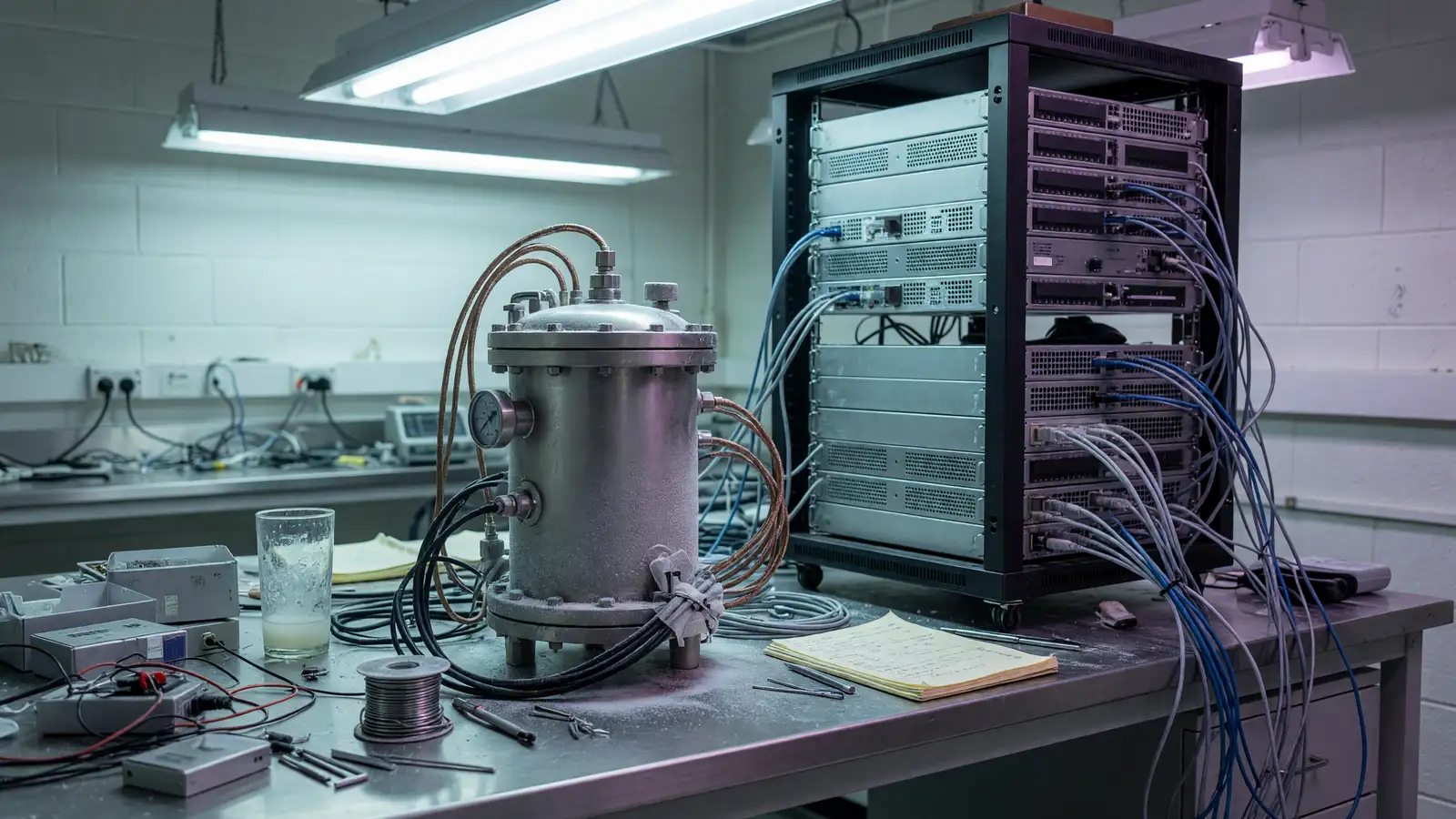
The overhead also has economic implications. Each physical qubit requires cryogenic cooling to near absolute zero (about 15 millikelvins), precise microwave control electronics, and sophisticated classical computing infrastructure for error decoding. A million-qubit quantum computer wouldn’t just be a physics challenge — it would be a cryogenics, electronics, and classical computing challenge of unprecedented scale. Current dilution refrigerators can cool maybe a few hundred qubits comfortably. Scaling to millions would require entirely new cooling architectures.
What Google and IBM are actually building
Google’s approach focuses on the Willow chip architecture, which uses superconducting transmon qubits arranged in a grid. The key innovation is not just the qubit count but the connectivity: Willow’s qubits are arranged so that error correction codes can be implemented with minimal overhead. Google has demonstrated that increasing the code distance from distance-3 to distance-5 to distance-7 progressively reduces logical error rates, exactly as theory predicts.
The Willow team has also made progress on real-time error decoding — the classical computing task of interpreting syndrome measurements (the error signals from the quantum hardware) and determining what corrections to apply. This is a nontrivial computational problem: the decoder must operate faster than the qubits decohere, or the corrections arrive too late to be useful. Google’s decoder processes syndrome data in real-time using custom FPGA hardware, achieving latencies below the qubit coherence time.
IBM’s strategy is different. Rather than building the largest possible single chip, IBM is pursuing a modular architecture: multiple Heron processors connected via classical and quantum interconnects. The idea is that you don’t need millions of qubits on a single chip if you can reliably connect multiple chips together. IBM’s quantum roadmap targets a 100,000+ qubit system by the end of the decade, built from interconnected modules.
IBM has also invested heavily in quantum middleware — the software layer that sits between quantum algorithms and quantum hardware. Their Qiskit Runtime system handles circuit optimization, error mitigation, and results aggregation, making it easier for developers to write quantum programs without deep expertise in hardware-level concerns.
Microsoft’s approach is the most radical. The Majorana 1 chip, announced in 2025, uses topological qubits — a fundamentally different type of qubit that is theoretically more resistant to errors by its physical nature. Topological qubits encode information in the global properties of a quantum system rather than in individual particles, making them inherently more robust against local noise. If topological qubits work as advertised, they could dramatically reduce the overhead required for error correction. But the technology is unproven at scale, and Microsoft has a history of ambitious quantum announcements that take years to materialize.
Where this leaves the timeline
The mainstream consensus among quantum computing researchers is that useful fault-tolerant quantum computing is still 5-10 years away. Some optimists point to the rapid progress in error correction and suggest we could see early fault-tolerant systems by 2028-2029. Skeptics note that the gap between “below threshold in a lab” and “millions of qubits in a reliable system” is not just an engineering challenge — it’s a manufacturing, cryogenics, and control systems challenge that has no precedent.
The financial industry is watching closely. Portfolio optimization, risk modeling, and derivatives pricing are among the first practical applications that could benefit from quantum computing. Several major banks have quantum computing research programs, and the financial sector has been willing to invest in a technology that might not pay off for years. The error correction milestone gives these investments more credibility, even if the timeline remains uncertain.
Pharmaceutical companies are also paying attention. Quantum simulation of molecular interactions could accelerate drug discovery, particularly for complex proteins that classical computers struggle to model. But these applications require error rates even lower than what Google and IBM have demonstrated — roughly 10^-12 or better for some molecular simulations, compared to the 10^-6 range achieved so far.
Materials science is another early use case. Simulating how materials behave at the quantum level could lead to better batteries, more efficient solar cells, and new superconductors. These are problems where classical computers hit fundamental limits, and quantum computers could provide answers that no amount of classical computing power could match.
The practical impact today
For most organizations, quantum error correction milestones are interesting but not actionable. No one is running production workloads on quantum computers today, and the error correction progress doesn’t change that. What it does change is the confidence level for long-term quantum computing investments.
Companies that have been holding off on quantum computing research because “it might never work” now have stronger evidence that the fundamental physics works. The challenge is engineering, not science. That’s a meaningful distinction for CTOs making multi-year technology bets.
The other practical impact is on the quantum computing workforce. As the field moves from “experimental physics” to “engineering at scale,” the skills gap shifts from quantum mechanics expertise to systems engineering, cryogenics, and classical control systems. Universities are starting to offer quantum engineering programs that blend physics with electrical engineering and computer science — a sign that the industry is preparing for the scaling challenge ahead.
There’s also a growing ecosystem of quantum computing software tools and frameworks. Companies like Qiskit (IBM), Cirq (Google), and PennyLane (Xanadu) are building the programming abstractions that will make quantum computing accessible to mainstream developers. The error correction milestone means these software investments are less likely to be wasted on hardware that never works.
The competitive landscape beyond the big three
Google, IBM, and Microsoft get most of the headlines, but the quantum computing ecosystem is much broader. IonQ, which uses trapped-ion technology rather than superconducting qubits, has achieved some of the highest gate fidelities in the field — over 99.9% for single-qubit gates and 99.5% for two-qubit gates. Their Forte Enterprise system offers 36 algorithmic qubits with lower error rates than superconducting alternatives, though at slower gate speeds.
PsiQuantum is taking a different approach entirely: building a photonic quantum computer that operates at room temperature (or close to it) and uses manufactured chips rather than laboratory-grade superconducting circuits. Their thesis is that photonic qubits can be manufactured using existing semiconductor fabrication facilities, which would solve the scaling problem that plagues superconducting approaches. The company raised over $700 million and has partnerships with GlobalFoundries for chip manufacturing.
Quantinuum, formed from the merger of Honeywell Quantum Solutions and Cambridge Quantum, operates the largest trapped-ion quantum computer and has demonstrated some of the highest quantum volumes in the industry. Their H-Series processor consistently outperforms superconducting systems on benchmark tasks, though trapped-ion systems face their own scaling challenges.
The diversity of approaches is healthy for the field. If superconducting qubits hit a scaling wall, trapped-ion or photonic approaches might find a different path to the same destination. And the error correction techniques developed for one architecture often transfer to others — the surface code, for example, is designed to be architecture-agnostic.
Bottom line
Quantum error correction below threshold is a genuine milestone. It validates decades of theoretical work and confirms that the path to fault-tolerant quantum computing is physically possible. But the engineering gap between “possible” and “practical” is measured in orders of magnitude of qubit count, not incremental improvements.
The race to useful quantum computing continues. Google, IBM, Microsoft, and a growing field of startups are all making progress. The finish line is visible, but it’s still a long way off.