IonQ's Decoder Runs on a Laptop Chip. The Quantum Part Still Doesn't.
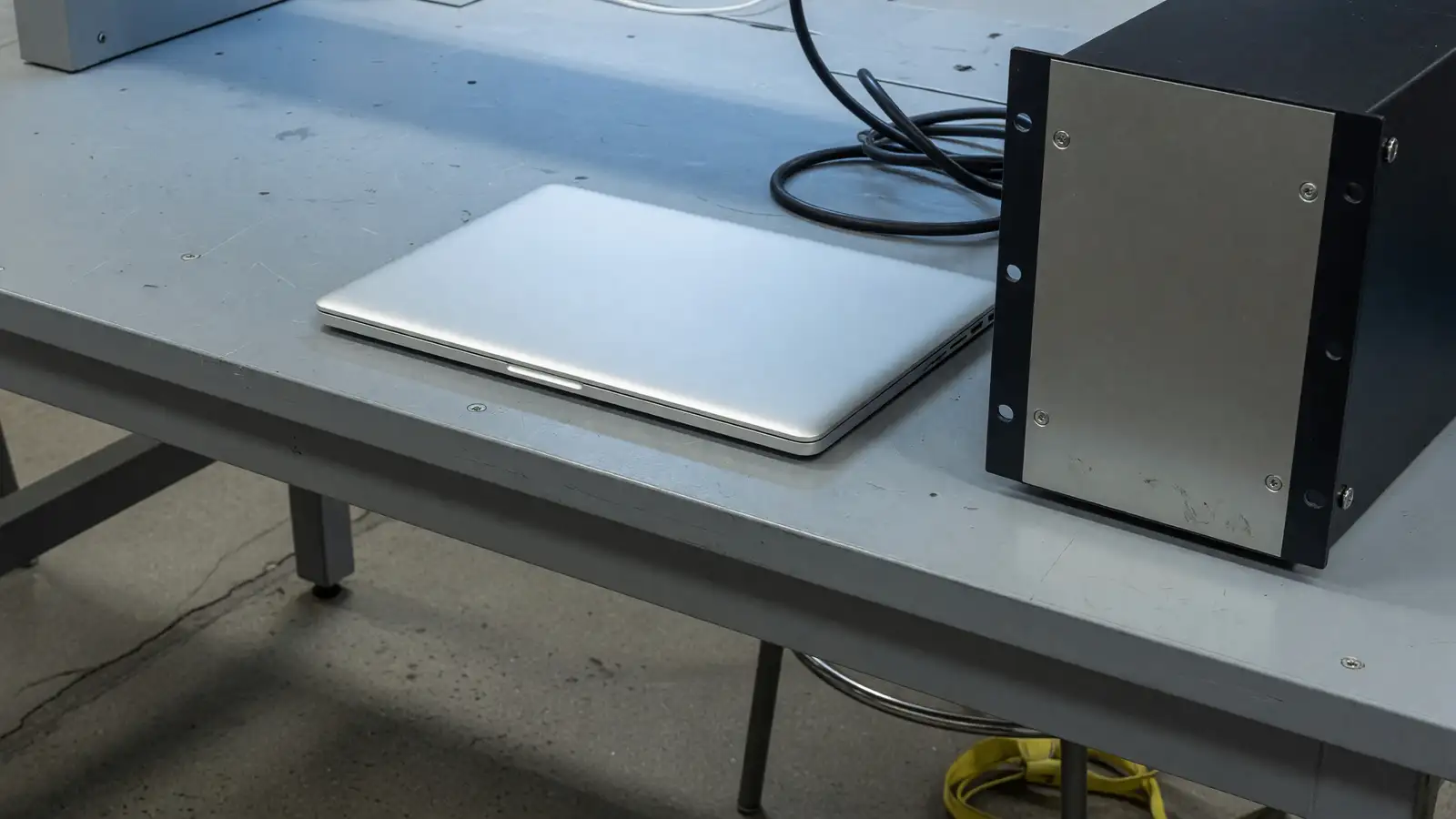
IonQ did not put a useful quantum computer on a ThinkPad this week. It said the boring half of fault tolerance — the classical decoder that listens to error syndromes and shouts corrections back — can run on one off-the-shelf CPU, in real time, without a rack of FPGAs.
The company dated the announcement to September 22 from College Park. Stock moved. A conference had a panel. The actual claim is narrower than the headlines, and still worth reading if you have been following the hardware pitches.
We already covered Superion 256 as a factory story. This is the software-shaped bottleneck next to it.
What they actually measured
The press release, and the arXiv paper it points at, describe a dual-decoder architecture tested on benchmark circuits that simulate up to 408 logical qubits across 88 memory blocks and magic factories. Those circuits executed more than 31.5 million individual quantum operations, the “MegaQuOp” scale the company likes to say out loud. Under standard operational noise, the decoder added as little as 0.02 percent stretch time — meaning the classical work barely lengthened the quantum run.
Quantum Zeitgeist quoted Nicolas Delfosse, a co-author and IonQ’s quantum research lead: validating real-time decoding across hundreds of logical qubits and millions of logical operations is an important milestone. The same write-up ties the result to IonQ’s Walking Cat architecture and argues classical hardware will not be the thing that stops the roadmap.
That last sentence is the fight. For years the folklore said that as you scale toward thousands of physical qubits, syndrome traffic becomes a firehose, and you need custom silicon or a GPU cluster sitting next to the trap just to keep up. TechTimes, on September 23, framed the result as a laptop chip being enough. The Quantum Computing Report, which the TechTimes piece cites, said classical decoding bandwidth should not bottleneck IonQ’s WCA roadmap toward 10,000-plus physical qubits.
Notice the verbs: simulate, benchmark, roadmap. This is not a demo where a trapped-ion machine in a lab ran 31.5 million fault-tolerant operations on Wednesday and decoded them on a Dell. It is an end-to-end decoder design, run against circuits that stand in for that load, on commodity silicon, with published math. That is a real paper. It is not a product SKU.
Why the decoder was the expensive assumption
Every cycle, the quantum processor dumps a stream of syndrome measurements. Those bits are not the computation. They are the smoke alarm. The decoder has to finish and return corrections before the next cycle, or the logical qubit you thought you were protecting is already garbage. Latency, not teraflops, is the constraint.
FPGA farms and custom ASICs showed up in other labs’ diagrams because worst-case decoding looked like a supercomputer problem. If IonQ’s dual-decoder design holds at MegaQuOp scale with 0.02 percent stretch on a CPU, two practical things change. First, the bill of materials next to the fridge gets cheaper. Second, you can iterate the decoder in software instead of waiting for a chip spin. Software iteration is how you find out the 0.02 percent was an average and the tail latency still blows a shot.
I would want to see the percentile, not the “as little as.” Worst-case stretch is what kills a logical gate. Averages are how you write a release.
The 408 logical qubits and 88 blocks are simulated sizes. Logical qubits are not physical ions. You still need the physical layer to be quiet enough that the decoder is correcting rare events, not drowning. IonQ’s 2025 claim of 99.99 percent two-qubit gate fidelity is the other half of that story, and it lives in the same boilerplate every Superion note recycles, including this week’s. Treat it as a 2025 lab number until someone publishes the 2026 operating number on the machine you can book.
Superion in 2027, at NVIDIA, on paper
HPCWire posted an off-the-wire item on September 23: IonQ plans a 2027 Superion installation at NVIDIA’s Quantum Research Center. The extract we got was mostly corporate about-copy — AWS, AstraZeneca, the 20x performance line, the 99.99 percent fidelity — so I am not going to invent rack counts. The dated headline is the fact: planned 2027, NVIDIA site, Superion class.
That timing is honest in a way the decoder headlines are not. A 2027 install is after the decoder paper, after whatever Superion units ship to earlier customers, and after NVIDIA’s own CUDA-Q stack keeps growing. We wrote about CUDA-Q Logical as software for qubits that do not exist yet. Putting a Superion next to that stack is how you stop the software from being a slide.
It is also how you end up with a press tour in 2027 that cites this week’s decoder paper as if the laptop in 2026 had been the machine. Keep the dates attached.
Stocks moved. That is not a benchmark.
Investor’s Business Daily said IONQ popped Wednesday after the decoder news at a large industry conference. Quantum names had been weak into the event. Fine. This site does not do buy/sell. A one-day pop tells you the tape had a headline. It does not tell you the 0.02 percent stretch survives contact with a larger code distance.
If you work in procurement, the question is whether the decoder is licensed, open, or stuck inside IonQ’s stack. The release does not make that clear. If it is proprietary, NVIDIA’s center gets a box that decodes IonQ’s way. If the arXiv method is enough to reimplement, other trapped-ion and superconducting groups will try it and publish where it breaks. I would wait for the second paper, from a lab that does not sell the CPU story.
How this sits next to Helios and Willow theater
QUOPS still says chemistry wants on the order of 250 million operations. 31.5 million is a step on that axis, in simulation. Helios and Willow fights are about physical qubits and error rates on hardware you can photograph. IonQ’s week is about not needing a custom decoder chip when those photographs get bigger.
You can believe both of these at once:
- Classical decoding was a real tax, and showing CPU-class latency at MegaQuOp scale is a genuine systems result.
- Fault-tolerant chemistry, logistics, and the rest of the slide deck still need the physical qubits, the logical error rate, and a 2027 calendar that slips.
The dishonest version is “laptop quantum computer.” The honest version is “the sidecar got cheaper, on paper, in September 2026.”
Dual decoder, magic factories, and why 0.02 percent can still lie
The IonQ note says dual-decoder. That usually means a fast approximate path plus a slower exact path, with a handoff when the cheap decoder is unsure. It is a classic way to keep average latency down. It is also how you hide a tail: the 0.02 percent stretch is the mean while the slow path still blows a shot at distance 7. If the paper (on arXiv, per the release) only quotes the friendly average, treat it like a CDN quoting mean TTFB.
Magic factories are the other tell. In fault-tolerant diagrams, magic states are the expensive resource you distill so you can do non-Clifford gates. Simulating 88 memory blocks and factories is how you generate a syndrome firehose without owning 10,000 ions. It is the right test if you are asking “will the CPU melt.” It is the wrong test if you are asking “does the trap stay coherent long enough for those factories to finish.” Those are different labs.
Walking Cat, in the Zeitgeist write-up, is the architecture this decoder is supposed to validate. I am not going to pretend I have a public spec for Walking Cat beyond what those articles gave. The procurement question is simpler: is the decoder tied to that architecture, or is it a method other groups can steal from arXiv. If it is tied, NVIDIA’s 2027 box decodes IonQ’s way and nobody else’s. If it is stealable, you will see superconducting groups try it and fail in public. Failure in public is the healthy outcome.
MegaQuOp — 10^6 quantum operations — is a marketing unit that happens to match a real scale. QUOPS still parks useful chemistry nearer 2.5×10^8. A decoder that keeps up at 3.15×10^7 in simulation is not a chemistry result. It is a claim that the sidecar is not the thing that fails first when someone else gets the operations.
Partners in the boilerplate — AWS, AstraZeneca, NVIDIA, the 20× line — are recycled from Superion notes we already flagged. They do not become new evidence because they sat under a decoder headline.
What to watch between now and the NVIDIA date
Watch for an independent reproduction of the stretch-time number at a higher distance. Watch whether 1.36-era control stacks (the classical PCs in the rack, not Kubernetes) actually drop the FPGA line item in a public BOM. Watch if the 2027 Superion at NVIDIA is a research hookup or a machine with a queue other people can submit to.
If you already discounted IonQ because the hardware essays read like foundry pitches, this paper is the first thing in a while that is shaped like a systems constraint being removed. If you already believed the Superion timeline, do not let a CPU decoder become proof that 10,000 physical qubits are around the corner. The Quantum Computing Report said the decoder will not be the bottleneck on the way there. That leaves every other bottleneck in place.
I will trust this when a user at the NVIDIA center files a job, the decoder runs on the boring server next to the trap, and the stretch time is in the job log, not in the release.
Conference week also produced the usual stock-tape noise. IBD said quantum names had been weak heading into the event. That is context for why a CPU decoder moved the ticker. It is not a second experiment. If you are reading this as a buyer, ignore the pop and ask for the arXiv ID plus a latency histogram. If they only have the mean, you do not have a decoder story yet. Ask, too, whether the 408 logical qubits in the benchmark share a noise model with the Superion they plan to park at NVIDIA in 2027. If the answer is “similar enough,” file it under marketing. If they can point to the same distance and the same cycle time, file it under engineering.