RWA Tokenization in 2026: How $26 Billion On-Chain Became the Gateway to a $16 Trillion Future
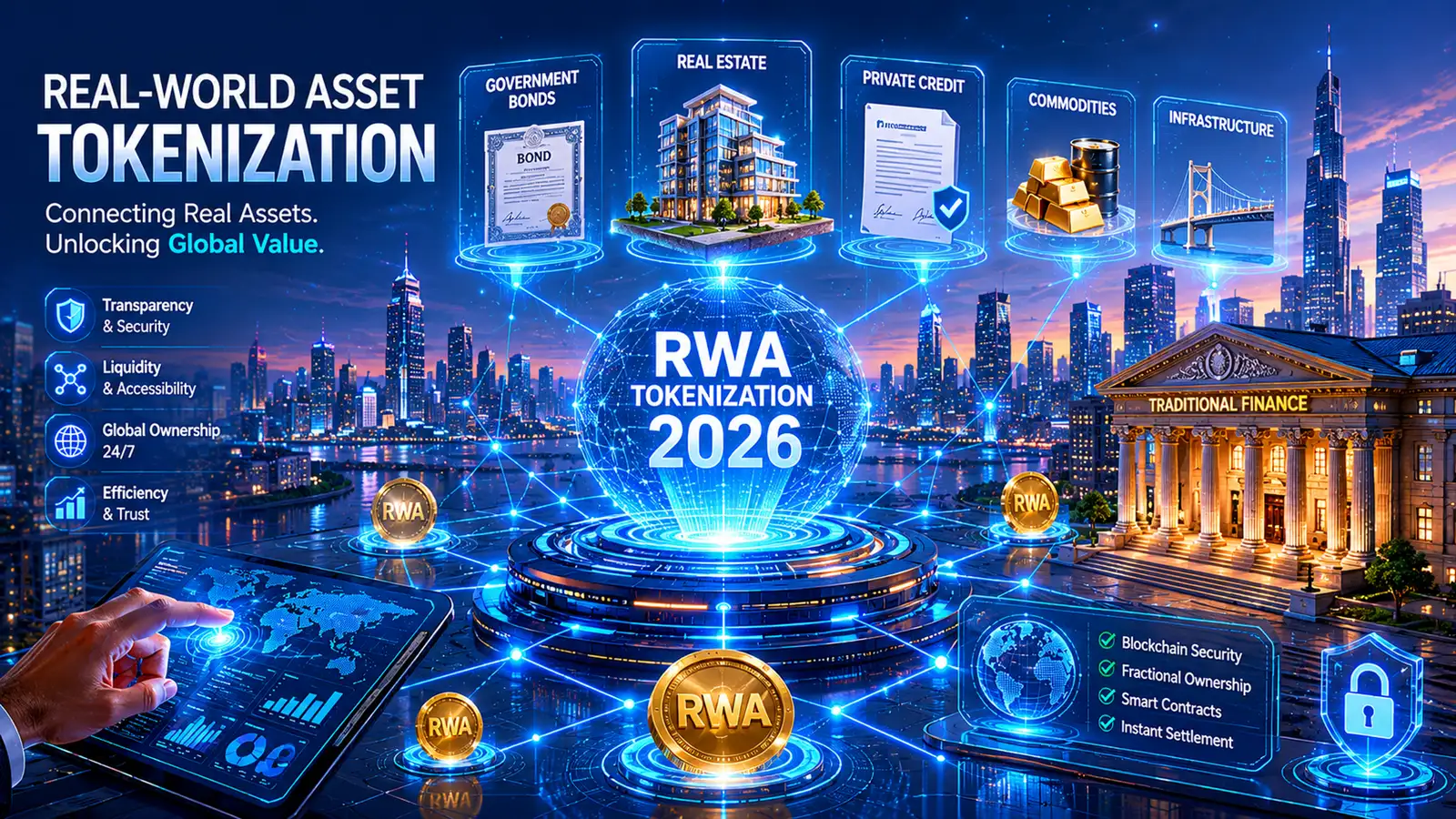
The total value of real-world assets sitting on public blockchains reached $26.77 billion as of March 2026. That number sounds impressive until you remember that the global stock and bond markets alone are worth well over $200 trillion. Less than 0.01 percent of investable wealth has been tokenized. That gap — several orders of magnitude — is precisely why institutional finance is moving so aggressively into this space right now.
RWA tokenization is no longer a speculative side project for crypto enthusiasts. In 2026, it has become a strategic priority for the largest asset managers, central banks, and regulatory bodies on the planet. Here is what has changed, what the numbers actually mean, and why the next five years could see tokenization reshape capital markets fundamentally.
What RWA Tokenization Actually Means
At its simplest, tokenization is the process of representing ownership of a physical or financial asset as a digital token on a blockchain. That token can be a share in a real estate property, a fraction of a treasury bond, or a claim on a commodity like gold. The token lives on a distributed ledger — most commonly Ethereum, Polygon, Stellar, or Solana — and its transfer, ownership history, and compliance rules are enforced by smart contracts rather than by manual paperwork.
The practical difference is settlement. Traditional financial markets typically settle on a T+2 cycle, meaning a trade takes two business days to finalize. Tokenized assets settle in minutes or seconds, 24 hours a day, seven days a week. That is not an incremental improvement — it is a structural change to how capital moves.
The Numbers Behind the 2026 Surge
The growth trajectory is difficult to ignore. In early 2022, the total value of tokenized RWAs on public blockchains sat at roughly $5 billion. By the first quarter of 2026, that figure had climbed to $26.77 billion — a more than fivefold increase in three years.
BlackRock’s BUIDL fund, a tokenized money market fund launched on Ethereum, has alone surpassed $2 billion in assets under management. For context, BUIDL represents tokenized U.S. Treasury exposure available for institutional allocation through on-chain infrastructure. It is not a retail product. It is not an experiment. It is a live, regulated financial instrument managed by the world’s largest asset manager.
Boston Consulting Group and Standard Chartered have independently projected that the tokenized RWA market could reach between $10 trillion and $16 trillion by 2030. Even if those estimates prove optimistic, the direction is unambiguous: tokenization is scaling from billions to trillions.
The Regulatory Inflection Point of 2026
Perhaps the most consequential development in 2026 has not been technical or financial — it has been regulatory. For years, the tokenization space operated in a gray zone, unsure of how securities law would apply to on-chain assets. That changed rapidly in the first quarter of 2026.
In January, the SEC issued its first formal statement specifically addressing tokenized securities. In February, the agency approved WisdomTree’s plan for 24/7 intraday trading of a tokenized money market fund — a landmark decision that effectively legitimized continuous on-chain trading for regulated products. In March, the SEC and CFTC released joint guidance on digital asset taxonomy, providing the clarity that institutional participants had been waiting for.
Simultaneously, the GENIUS Act advanced through Congress, establishing a regulatory framework for stablecoins that complements the broader tokenization infrastructure. Senate Banking Committee discussions have also explored rules for non-custodial secondary trading of tokenized securities in decentralized markets, provided those tokens embed compliance capabilities comparable to existing Bank Secrecy Act requirements.
The cumulative effect of these moves is a regulatory environment that no longer treats tokenization as an edge case. It is being integrated into the formal architecture of U.S. financial regulation.
Who Is Building This Infrastructure
The list of institutional participants reads like a roster of traditional finance’s most powerful names.
BlackRock leads with its BUIDL fund, which has become the flagship example of how a traditional asset manager can deliver institutional-grade tokenized products on public blockchain infrastructure. The fund is accessible through multiple platforms and provides tokenized exposure to U.S. Treasury bills with daily dividend distributions recorded on-chain.
Fidelity and JPMorgan have both developed parallel tokenization initiatives. JPMorgan’s Onyx platform has been processing billions in tokenized transactions, while Fidelity has explored tokenized fund structures that mirror its existing mutual fund offerings.
WisdomTree, traditionally known for its ETF products, has positioned itself at the intersection of tokenized funds and continuous trading. Its SEC-approved intraday trading plan for a tokenized money market fund represents a bridge between the traditional ETF model and the 24/7 liquidity that blockchain enables.
Asian financial institutions deserve a separate mention. Multiple analyses have identified Asia as the most mature ecosystem globally for regulated Web3 activity, with jurisdictions like Hong Kong and Singapore offering clear licensing frameworks for digital asset businesses. The breadth of institutional roles in Asia — exchanges, banks, asset managers, and technology conglomerates working within defined regulatory boundaries — creates a model that other regions are studying closely.
The Asset Classes Being Tokenized
Tokenization is not limited to a single type of asset. The categories currently seeing the most activity include:
Treasury securities and bonds. These dominate the tokenized RWA market because they offer stable yields and are familiar to institutional investors. Tokenized Treasury products like BUIDL have demonstrated that on-chain yield-bearing assets can attract significant institutional capital.
Money market funds. The tokenization of money market funds has proven particularly popular because these funds require daily liquidity and transparent NAV reporting — both of which are naturally served by on-chain infrastructure.
Real estate. Property tokenization allows fractional ownership of commercial and residential real estate, reducing the capital requirements for participation and improving liquidity in an asset class that has historically been illiquid.
Private credit. Tokenized private credit markets allow institutional investors to access lending opportunities that were previously restricted to a small group of direct lenders. On-chain representation improves transparency and enables secondary market trading.
Commodities. Gold, silver, and other commodities have been tokenized for several years, but 2026 has seen increased institutional participation in tokenized commodity products that integrate with broader DeFi strategies.
The Technical Infrastructure Enabling Growth
Several blockchain networks have emerged as the primary infrastructure for RWA tokenization, each with different strengths.
Ethereum remains the dominant platform for institutional-grade tokenization. Its security model, developer ecosystem, and the maturity of its Layer 2 scaling solutions make it the default choice for products that require the highest levels of auditability and compliance.
Polygon has gained traction as a lower-cost alternative for tokenized assets that do not require Ethereum’s base-layer security guarantees. Its compatibility with Ethereum’s tooling and its established presence in enterprise blockchain solutions make it a practical choice for many tokenization projects.
Stellar has been purpose-built for asset issuance and cross-border transfers. Its native support for asset tokens and its focus on regulatory compliance through features like anchored assets make it attractive for tokenized securities that need to interact with traditional banking infrastructure.
Solana has emerged as a high-throughput option for tokenized assets that require fast settlement and low transaction costs. Its growing DeFi ecosystem provides natural composability for tokenized RWAs that want to participate in on-chain financial strategies.
The common thread across all these networks is the shift from proof-of-concept to production. Tokenized assets in 2026 are not running on testnets or permissioned pilot chains. They are live on public blockchains, handling real capital, and subject to real regulatory oversight.
Why Institutions Are Moving Now
The convergence of three factors has created the conditions for institutional adoption at scale in 2026.
Regulatory clarity is the first and most important. The SEC’s formal statements, the WisdomTree approval, and the joint SEC-CFTC guidance have removed the legal uncertainty that kept many institutions on the sidelines. When the regulator tells you how to do something legally, the barrier to entry drops dramatically.
Infrastructure maturity is the second. The blockchain networks, smart contract frameworks, and compliance tooling needed for tokenization have reached a level of reliability and security that institutional risk committees can accept. This is not a technology that works in theory — it is a technology that is processing billions of dollars in live transactions.
Competitive pressure is the third. When BlackRock launches a tokenized fund and it reaches $2 billion in AUM, other asset managers cannot afford to ignore the channel. Tokenization has moved from an optional innovation to a competitive necessity for firms that want to offer their clients the most efficient access to yield and liquidity.
The DeFi Connection
One of the most interesting developments in 2026 has been the way tokenized RWAs are beginning to integrate with decentralized finance protocols. Tokenized Treasury products can be used as collateral in lending protocols. Tokenized real estate can be fractionalized and traded on decentralized exchanges. Tokenized commodities can be hedged using on-chain derivatives.
This composability — the ability to combine tokenized traditional assets with DeFi primitives — creates financial strategies that were simply not possible before. An institution holding tokenized Treasury exposure can simultaneously earn yield from the underlying asset and participate in DeFi liquidity provision, all within a single on-chain portfolio.
This is not to suggest that the integration is seamless. Compliance requirements, oracle reliability, and smart contract risk remain real concerns. But the direction of travel is clear: the boundary between traditional finance and DeFi is becoming porous, and tokenized RWAs are the bridge.
What Comes Next
The projection of a $16 trillion tokenized RWA market by 2030 is not a guarantee, but it is a plausible scenario if current trends continue. The key milestones to watch over the next 12 to 18 months include:
-
Expansion of SEC-approved tokenized products. The WisdomTree approval was a single product. The question is whether it becomes a template for a broader class of tokenized securities eligible for continuous on-chain trading.
-
Cross-border tokenization frameworks. The Asian regulatory model is being studied by other jurisdictions. Harmonized or mutually recognized frameworks for tokenized assets across major financial centers would dramatically accelerate adoption.
-
Tokenization of new asset classes. Intellectual property, carbon credits, and revenue-sharing agreements are all candidates for tokenization. Each new asset class that successfully tokenizes expands the total addressable market.
-
Integration with central bank digital currencies. Several central banks are exploring CBDCs, and the interaction between CBDCs and tokenized RWAs could create entirely new settlement infrastructures that combine the speed of digital currency with the asset diversity of tokenized markets.
The Bottom Line
RWA tokenization in 2026 has crossed the threshold from experimental to essential. The $26.77 billion currently on-chain is not the end state — it is the opening position. When the world’s largest asset manager, the primary U.S. financial regulators, and the most established blockchain networks are all aligned on the same infrastructure project, the question is no longer whether tokenization will reshape capital markets. The question is how quickly it will happen.
For anyone paying attention to the intersection of blockchain technology and traditional finance, 2026 is the year to watch. The pieces are in place. The regulatory framework is taking shape. The institutional capital is flowing. The only variable left is scale.