Blockchain in Supply Chain: Transparency and Traceability Redefined
Consumers want to know where their products come from. Businesses face mounting pressure to prove ethical sourcing. The COVID-19 pandemic exposed critical vulnerabilities in global supply chains, from delayed shipments to counterfeit products. These problems aren’t new, but they’re getting harder to ignore.
Traditional supply chain management relies on manual processes, paper-based records, and fragmented systems that lack real-time visibility. This opacity creates opportunities for fraud and contamination that cost billions of dollars and, in some cases, human lives. According to the World Health Organization, approximately 600 million people fall ill after eating contaminated food each year, with 420,000 deaths. Many of these could be prevented with better traceability systems.
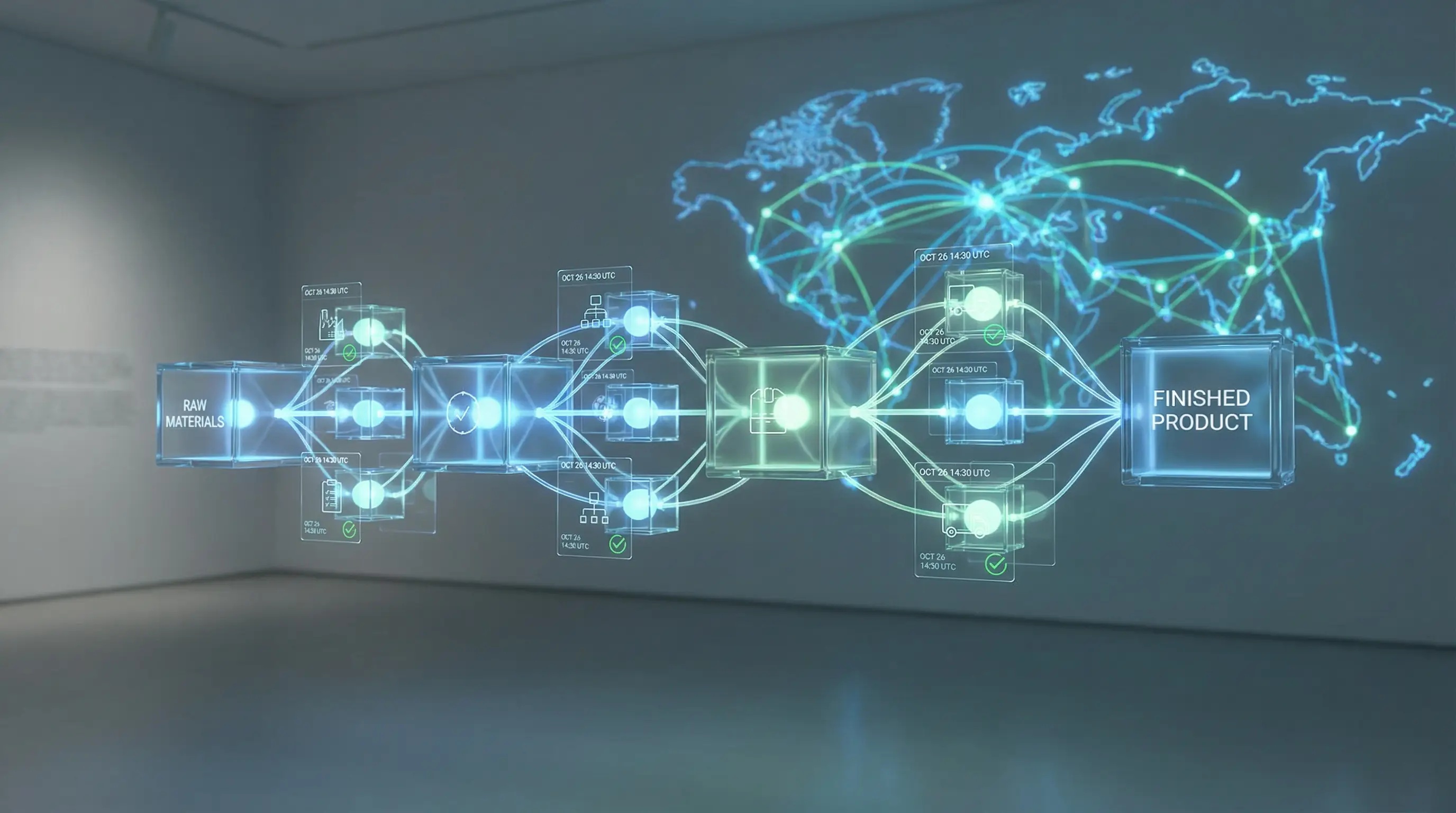
Blockchain technology offers a different approach. By creating an immutable, distributed ledger that records every transaction across the supply chain, it provides transparency and accountability that wasn’t possible before. From farm to table, mine to market, and factory to consumer, every step of a product’s journey can be tracked, verified, and audited in real-time.
This article examines how leading companies are using blockchain to transform their supply chains, with real-world implementations that show measurable improvements in traceability and efficiency.
The Challenge: Traditional Supply Chain Limitations
Modern supply chains are complex, often involving dozens of stakeholders across multiple countries. A single product might pass through farmers, processors, distributors, customs officials, shippers, and retailers before reaching the end consumer. Each handoff is a potential point of failure where information can be lost, manipulated, or delayed.
Manual Processes and Paper-Based Records
Despite technological advances, many supply chains still rely on manual recordkeeping and paper-based documentation. This creates several problems.
Paper records can be easily altered or forged without detection. Bad actors can manipulate invoices, falsify product standards, or misrepresent origins to suit their interests. Food fraud alone results in damages of $30 to $40 billion annually worldwide.
When contamination or quality issues arise, tracing products back to their source can take days or even weeks. In 2016, when Walmart attempted to trace a package of sliced mangoes to its source, the process took nearly seven days. That’s an eternity when dealing with potential foodborne illness outbreaks.
Different stakeholders often use incompatible systems that don’t communicate with each other. This creates information silos where critical data remains trapped within individual organizations, making end-to-end visibility nearly impossible.
Real-World Consequences
The consequences are severe.
In Germany, a foodborne outbreak traced back to fenugreek seeds from Egypt resulted in 50 deaths and 4,000 illnesses. The incident cost the European Union food industry €1.3 billion and Egypt approximately $4.2 billion in lost exports.
According to the UN Environment Programme’s Food Waste Index Report 2021, about 17% of global food production goes to waste, with 13% coming from retail. Much of this waste results from overly broad recalls when contamination cannot be precisely traced to specific batches.
The “Food Safety Supply Chain Vision Study” found that only 20% of global consumers place complete trust in companies to ensure food safety. That’s a troubling statistic that reflects the industry’s transparency challenges.
How Blockchain Transforms Supply Chain Transparency
Blockchain technology addresses these challenges by creating a shared, immutable record of transactions that all authorized participants can access and verify. Unlike traditional databases controlled by a single entity, blockchain distributes data across a network of computers, making it virtually impossible to alter records without detection.
Core Blockchain Capabilities
Every transaction is recorded on a blockchain that multiple parties can access simultaneously. This creates a single source of truth that eliminates discrepancies between different stakeholders’ records.
Once data is recorded on a blockchain, it cannot be changed or deleted. This tamper-resistant quality ensures the integrity of supply chain records and creates an auditable trail of every transaction.
Blockchain provides instant access to supply chain data. Stakeholders can track products in real-time, verify authenticity, and identify issues before they escalate into major problems.
Smart contracts are self-executing agreements that automatically trigger actions when predefined conditions are met. For example, payment can be released automatically when a shipment arrives and passes inspection.
Technical Implementation
Modern blockchain supply chain solutions typically combine several technologies.
Each product, batch, or shipment receives a unique digital identifier registered on the blockchain. This identifier serves as an address that links to all relevant information about that item.
Digital certificates issued by trusted parties (such as organic certifications, quality inspections, or shipping confirmations) are cryptographically secured and linked to product identifiers. These credentials can be instantly verified without contacting the issuing authority.
Sensors attached to products or shipping containers continuously collect data (temperature, location, humidity) and automatically record it on the blockchain, creating an unbroken chain of custody.
Many enterprise blockchain solutions use Hyperledger Fabric, an open-source framework that provides the security and scalability needed for large-scale supply chain implementations.
Real-World Case Studies
The true power of blockchain in supply chain management becomes clear when examining actual implementations. The following case studies show how leading companies have achieved measurable improvements.
Case Study 1: Walmart - Food Traceability Revolution
Walmart’s blockchain initiative is one of the most successful and well-documented supply chain transformations in the industry. The retail giant’s journey began in 2016 when its Vice President of Food Safety asked his team to trace a package of sliced mangoes to its source. The process took 6 days, 18 hours, and 26 minutes. Far too long to effectively respond to a potential contamination outbreak.
Walmart partnered with IBM to implement a food traceability system based on Hyperledger Fabric. The results were dramatic: the same mango tracing exercise that previously took nearly seven days could now be completed in just 2.2 seconds.
In China, Walmart collaborated with JD.com, IBM, and Tsinghua University to build a blockchain ledger tracking pork movement through the supply chain. Certificates of authenticity were uploaded to the blockchain. By September 2018, Walmart could trace over 25 products from five different suppliers, including mangoes, leafy greens, strawberries, dairy products, meat, poultry, and baby food.
In 2018, Walmart announced its Blockchain-Enabled Food Traceability Initiative, requiring all fresh leafy greens suppliers to capture and transmit traceability data using the IBM Food Trust network. Suppliers must record product IDs, lot/batch codes, purchase orders, and date/time codes for harvesting, processing, shipping, and receiving.
By 2019, Walmart China launched its Blockchain Traceability Platform with 23 product lines, powered by VeChain’s blockchain technology. The company also piloted blockchain tracking for shrimp sourced in Andhra Pradesh, India, and shipped to Sam’s Club locations in the USA. This was the first known use of blockchain to track shrimp exports from farms to overseas retailers.
The improved visibility lets Walmart manage suppliers better, conduct more efficient quality checks, and drastically reduce time and costs throughout the supply chain. More importantly, it allows for rapid containment of foodborne illness outbreaks and selective recalls that minimize waste.
Case Study 2: Maersk & IBM - TradeLens Platform
Global shipping giant Maersk partnered with IBM to create TradeLens, a blockchain-powered platform designed to digitize and streamline the global shipping industry. The platform addresses the massive inefficiency created by paper-based documentation in international trade.
International shipping involves complex documentation requirements, with a single shipment potentially requiring approval from dozens of different parties. This paperwork can cost more than the physical transportation of goods and creates opportunities for delays, errors, and fraud.
TradeLens uses blockchain to create a shared, immutable record of shipping documentation and cargo movement. All parties (including shippers, freight forwarders, ocean carriers, ports, and customs authorities) can access the same information in real-time.
The platform provides real-time tracking of cargo ships and containers, automated transaction processing along the supply chain, reduced documentation errors and processing times, and better visibility for all stakeholders.
The platform has helped reduce transit times, lower costs, and improve the accuracy of shipping documentation. By eliminating redundant paperwork, TradeLens shows how blockchain can transform even the most traditional industries.
Case Study 3: Pharmaceutical Supply Chain - Fighting Counterfeit Drugs
The pharmaceutical industry faces a critical challenge: counterfeit drugs that endanger patient safety and cost the industry billions of dollars annually. Blockchain technology offers a powerful solution for ensuring drug authenticity and traceability.
Deloitte developed a proof of concept called BioTrack & Trace for managing biological samples in clinical trials. The system brings consent, biosample collection, storage, sharing, and analysis processes onto a single blockchain platform.
Doctors, clinical trial sites, biobank managers, and researchers can track a sample’s location and understand how it was collected and used. Trial participants can verify the level of consent they provided and gain insights into study results. The system improves tracking mechanisms and consent management across the clinical trial value chain.
In Japan, Mitsubishi Logistics built a blockchain tracker for drug deliveries, ensuring that pharmaceutical products maintain proper storage conditions throughout the supply chain. Temperature data and location information are automatically recorded on the blockchain, providing irrefutable proof of proper handling.
According to a Deloitte study, blockchain technology in pharmaceutical supply chains can reduce the time required to track a product from its origin from days to seconds, while also preventing the distribution of counterfeit medications.
Case Study 4: De Beers - Diamond Traceability
The diamond industry has long struggled with “conflict diamonds” (gems mined in war zones and sold to finance armed conflict). De Beers, one of the world’s largest diamond companies, implemented blockchain to ensure ethical sourcing and verify diamond authenticity.
De Beers tracked 100 high-value diamonds along the supply chain from mine to retail. Each diamond receives a unique digital identity on the blockchain, with every transaction recorded as it moves through cutting, polishing, and retail.
The system helps avoid the trade of conflict diamonds by providing verifiable proof of origin. Buyers can trust the provenance of valuable and polished diamonds, protecting against fraud and counterfeiting.
Retailers can provide customers with complete histories of their diamonds, including where they were mined, when they were cut and polished, and every transaction in between. All verified on the blockchain.
Case Study 5: Nestlé - Coffee Supply Chain Transparency
Nestlé uses blockchain to improve transparency for its luxury coffee brand Zoégas, which sources beans from Brazil, Rwanda, and Colombia. The implementation shows how blockchain can build consumer trust through transparency.
Customers can scan a QR code on the coffee package to access blockchain data including information about the farmers who grew the beans, transaction certificates for specific shipments, time of harvest and roasting period, and complete journey from farm to store.
This transparency helps Nestlé meet growing consumer demand for sustainably sourced products. Studies show that 79% of consumers say it’s important for brands to provide guaranteed authenticity through certifications, and 71% are willing to pay a premium for companies offering full transparency and traceability.
Smart Contracts: Automating Supply Chain Operations
Smart contracts are one of blockchain’s most powerful features for supply chain management. These self-executing agreements automatically perform actions when predefined conditions are met.
Procurement and Automated Payments
Traditional procurement involves manual negotiation, purchase orders, invoices, and letters of credit that require human validation at each step. Smart contracts streamline this process dramatically.
When a supplier meets predefined conditions (such as a shipment arriving and passing inspection), the smart contract automatically releases payment from an escrow account. This cuts payment delays and reduces administrative overhead.
Funds are held securely and only released when both buyer and seller approve the transaction, providing protection for both parties.
Real-time data from decentralized oracles (such as Chainlink) can adjust contract terms based on market prices or demand fluctuations, ensuring fair pricing throughout the supply chain.
Logistics and Shipment Tracking
Smart contracts combined with IoT sensors create powerful logistics solutions.
Sensors on shipping containers continuously log GPS location, temperature, and humidity data, storing it on the blockchain. If conditions deviate from acceptable ranges, the smart contract can automatically trigger alerts or insurance claims.
Each shipment can be tokenized as a Non-Fungible Token (NFT), creating a unique digital certificate that verifies authenticity and ownership. This prevents counterfeiting and simplifies ownership transfers.
If a shipment arrives damaged or late, smart contracts can automatically process insurance claims or refunds based on the blockchain-recorded evidence.
Inventory and Warehouse Management
Smart contracts optimize warehouse operations through automation.
When inventory levels fall below a predetermined threshold, smart contracts automatically trigger new orders, ensuring optimal stock levels without manual monitoring.
Federated learning algorithms analyze warehouse trends to optimize inventory distribution, with smart contracts automatically adjusting orders based on predicted demand.
Warehouses can be managed by self-governing smart contract rules, reducing administrative overhead and ensuring consistent policy enforcement.
Cross-Border Trade and Customs Compliance
International trade involves complex customs clearance and regulatory approvals. Smart contracts simplify this process.
Smart contracts verify customs duties, VAT payments, and tariff classifications in real-time, reducing delays at borders.
Zero-Knowledge Proofs (zk-SNARKs) allow businesses to prove compliance with regulations without exposing sensitive commercial data to competitors or unauthorized parties.
Smart contracts can connect different blockchain ecosystems (Ethereum, Polkadot, Hyperledger) to ensure seamless international trade across various platforms.
Benefits of Blockchain in Supply Chain
The case studies and implementations discussed above show numerous tangible benefits that blockchain brings to supply chain management.
Blockchain creates a single source of truth accessible to all authorized participants. This transparency builds trust among parties who may not know each other and eliminates the information asymmetry that plagues traditional supply chains. Consumers can verify product origins and ethical sourcing claims, while businesses can prove compliance with regulations and standards.
The ability to trace products in seconds rather than days or weeks allows rapid response to contamination outbreaks. Selective recalls based on precise batch identification reduce waste and minimize economic impact. Walmart’s reduction from seven days to 2.2 seconds for tracing mangoes exemplifies this benefit.
Immutable blockchain records make it extremely difficult to manipulate data or introduce counterfeit products into the supply chain. The pharmaceutical and diamond industries have seen significant reductions in counterfeiting through blockchain implementation.
While blockchain implementation requires upfront investment, it delivers substantial cost savings through reduced administrative overhead from automated processes, fewer disputes requiring manual resolution, lower insurance costs due to better risk management, decreased waste from more precise recalls, and elimination of intermediaries in certain transactions.
Blockchain allows accurate tracking of Scope 3 emissions and environmental impact throughout the supply chain. Companies can verify sustainable sourcing claims and show progress toward ESG (Environmental, Social, and Governance) goals with irrefutable data.
Transparency builds consumer trust. Studies show that products with blockchain-verified sustainability credentials sell for 7-22% more than those without verification. Consumers increasingly demand proof of ethical sourcing, and blockchain provides that proof in an easily accessible format.
Implementation Challenges
Blockchain implementation in supply chains faces several significant challenges that organizations must address.
Different blockchain platforms often cannot communicate with each other, creating new silos. “Bridges” that connect different blockchains exist but may introduce security vulnerabilities or require trusted intermediaries, partially defeating blockchain’s trustless nature. Industry-wide standards for blockchain interoperability remain under development.
Public blockchains like Ethereum can face high transaction fees and slow processing times during periods of high demand. While solutions like Layer 2 scaling (zk-Rollups, Optimistic Rollups) and high-performance blockchains (Solana, Polkadot) address these issues, they often involve trade-offs between decentralization, security, and speed.
Private or permissioned blockchains used by enterprises typically handle scalability better by using lighter-weight consensus mechanisms and high-performance hardware, but they sacrifice some of the decentralization benefits of public blockchains.
Integrating blockchain into existing supply chain systems requires significant investment. Research indicates that companies typically invest between $250,000 and $2 million in blockchain implementations, depending on complexity. Additional costs include staff training, ongoing maintenance, and potential system upgrades.
Blockchain networks become more valuable as more participants join, but achieving critical mass requires convincing numerous independent stakeholders to adopt new technology and processes. Resistance to change, particularly among organizations comfortable with existing systems, can slow adoption.
Supply chains involve many parties (suppliers, manufacturers, shippers, customs officials, and retailers), each with different priorities and technical capabilities. Achieving consensus on standards, governance, and data sharing protocols requires extensive coordination.
Legal frameworks for blockchain-based contracts and transactions remain under development in many jurisdictions. Questions about data privacy (particularly GDPR’s “right to be forgotten” versus blockchain’s immutability), cross-border data flows, and legal recognition of smart contracts create uncertainty for enterprises.
While blockchain provides transparency, businesses often need to protect sensitive commercial information from competitors. Solutions like zero-knowledge proofs and private transactions exist but add complexity and may reduce some of blockchain’s transparency benefits.
What’s Next for Blockchain in Supply Chain
As we move through 2026 and beyond, several trends are shaping blockchain in supply chain management.
The integration of artificial intelligence with blockchain is creating more sophisticated supply chain solutions. AI algorithms can analyze blockchain data to predict supply chain disruptions, optimize routing, and automatically adjust smart contract parameters based on real-world conditions. Decentralized Autonomous Organizations (DAOs) powered by AI will increasingly manage complex supply chain operations with minimal human intervention.
Environmental concerns are driving blockchain adoption for sustainability tracking. Proof-of-Stake (PoS) consensus mechanisms, which reduce energy consumption by approximately 99.95% compared to Proof-of-Work systems, are becoming the standard for new blockchain implementations. Companies are using blockchain to track carbon footprints, verify sustainable sourcing, and show progress toward net-zero commitments.
Organizations like the World Economic Forum and GS1 are working to establish industry-wide standards for blockchain supply chain implementations. These standards will improve interoperability, reduce implementation costs, and accelerate adoption by providing proven frameworks and best practices.
As quantum computing advances, blockchain systems are incorporating quantum-resistant cryptographic algorithms to ensure long-term security. This forward-looking approach protects supply chain data against future technological threats.
Enterprises are increasingly adopting hybrid approaches that combine public blockchains (for transparency and decentralization) with private networks (for speed and confidentiality). These hybrid models offer the best of both worlds, allowing companies to maintain competitive advantages while participating in industry-wide transparency initiatives.
Blockchain allows new financial models for supply chains, including tokenized assets, fractional ownership, and decentralized finance (DeFi) solutions that provide faster, cheaper access to working capital for suppliers, particularly small and medium-sized enterprises that traditionally struggle with supply chain financing.
Conclusion
Blockchain technology is redefining transparency and traceability in supply chain management. The case studies examined in this article (from Walmart’s food traceability to Maersk’s shipping platform, pharmaceutical supply chain innovations, and De Beers’ diamond tracking) show that blockchain delivers measurable benefits.
The technology’s ability to create immutable, transparent records accessible to all authorized participants addresses long-standing challenges in supply chain management: fraud, lack of visibility, and slow response times to contamination or quality issues. Smart contracts automate processes that previously required manual intervention.
However, successful blockchain implementation requires careful consideration of challenges including interoperability, scalability, implementation costs, and stakeholder adoption. Organizations must develop clear strategies, establish governance frameworks, and invest in the technical expertise needed to realize blockchain’s full potential.
As we progress through 2026 and beyond, blockchain technology continues to mature. Integration with AI, IoT, and other emerging technologies is creating increasingly sophisticated supply chain solutions. Industry standardization efforts are reducing implementation barriers, while sustainable blockchain protocols address environmental concerns.
For organizations seeking to build resilient and efficient supply chains, blockchain is no longer a futuristic concept. It’s a practical solution delivering real results today. The question is no longer whether to adopt blockchain, but how quickly organizations can implement it to gain competitive advantages in an increasingly transparent and accountable global marketplace.